ELEPHANT SNOT
“Slick as elephant snot” is a phrase I love to use (ask my wife). It is not neat or tidy substance. However, it is necessary for good elephant health.
On the other hand, it is also a product manufactured to remove graffiti. According to their website: “ELEPHANT SNOT® penetrates deeply into concrete, cement, brick, grout, stone, virtually anything porous to dissolve and loosen all types of tags, and in many circumstances, simple water hose pressure will do the job.” Good to know??
Did one cause the other, or did someone just think it was a descriptive and memorable name? I don’t know.
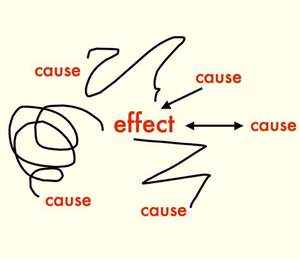
Which brings up the topic of causality, which in reality also is not a neat and tidy substance. “Correlation is not the same as causation.”
The number one problem with asserting a “cause” is that many times there are several contributing causes. What started the wild fire on the mountainside? The experts claim it was “caused” by a cigarette; thus, man-made. But were there other factors? We do know that thousands of cigarettes are tossed daily without causing fires. Maybe the cigarette was able to start the fire because it had not rained in 2 weeks. Maybe the wind blew the cigarette 3 feet off the road into thick weeds. Maybe the grass and undergrowth had not been trimmed back. Were there other factors? So, the human “cause” is only PART of the story. It is not the only activity which could have caused the conflagration. The grass next to the road’s edge could be trimmed more often. Water trucks could spray along roads during dry weather. Even high wind warnings could be posted. Yet, even these human attempts cannot stop all causes, like lightning.
You could imagine that since there are 17 brands of dish soap that many humans experience grave difficulty when it comes to washing dishes. Correlation may not imply what we might want to think. In this case it has NOTHING to do with how difficult dish washing might be. It has EVERYTHING to do with the number of companies which believe they can make a profit selling dish soap. So, we might easily come to a false conclusion if we do not know some additional facts. Correlation is not the same as causation.
Let’s say that in Pittsburgh 60% of unsanitary dwellings are occupied by people older than 50 and only 8% by people younger than 30. Hmmm! So, 50 year olds are more likely to CAUSE their dwellings to be unsanitary? SEE? You should not assume there is any causation with these statistics. All I did was state some correlations. Occupying an unsanitary dwelling is not the same as CAUSING the dwelling to be unsanitary. We need a lot more information to conclude causation.
We have some real world illustrations of this problem.
1) “A high % of former students are having trouble paying off their loans.” Is this causation or correlation? More information is needed. We should be asking many questions. How much did they borrow? What degrees did they pursue? Are they having trouble paying off their loans because they over-borrowed, they are unwilling to work unless it is in their field of study, or because some agency cheated them?
2) “A larger-than-expected number of prison inmates are black.” Is this causation or correlation? More information is needed. Some assume that the cause is unfair policing. Is that the cause? Is that part of the cause? I doubt the police are in the habit of arresting a black for a crime where the witnesses claimed the “perp” was Asian. I wonder how many have ever read a study which broke down the known causes.
Why is it so hard to find causality when it is so easy to find correlation? Correlation is merely a matter of objects or ideas which have some sort of relationship. When there is a car accident sometimes people become injured or die. Wow! We have just found correlation. When you drink a cup of coffee a short time later you find yourself walking into a bathroom. Wow! We have just found correlation. So, did the injuries cause the auto accidents or the accidents cause the injuries? For one person I know, the injury CAUSED both the accident and death of the driver (ruptured spleen just prior to the accident). Did the bathroom cause the desire to drink coffee or did the coffee create an urge to go to the bathroom? You may think you know. But do you? Did one event CAUSE the other?
Perusing articles where the writer comments on the “causes” of events … it appears that most neither understand, nor explain to the readers, that there are 2 types of causality: Necessary and Sufficient. However, the difference between these 2 types of causalities is great.
Necessary: Take the number 2, as an example. IF 2 cannot be “caused” unless the number 1 is present, THEN 1 is a Necessary “cause” of 2. Much proof is required to assert that “no other agent” could be deemed Necessary to “cause” 2.
Sufficient: Take the number 2 again. IF the presence of 1 implies the occurrence of 2, then 1 is a Sufficient “cause.” Since 1 is not the “only possible cause,” much proof is required to assert that 1 WAS the primary “cause” in this instance.
In both of these examples there are other possible causative factors. 1 may be a Necessary “cause,” but may require other contributions to make 2 happen. Equally, 1 may be a Sufficient “cause,” but MAY NOT be Necessary (maybe 3 caused 2 to happen this time).
Is that too technical?
To put this into a practical sense: We return to the coffee/bathroom example (above). Is coffee a Necessary or Sufficient “cause” of the urge to use the bathroom? Clearly, coffee is not always the “cause” is it? It, then, falls into the Sufficient category. Eating too much watermelon, drinking a can of soda, or even (gasp) drinking unfiltered tap water can “cause” the urge. Other contributing factors??? Maybe the person with the urge is also being prescribed a heart medication (water pills) which create an urge more often.
In fact, quite often we may know WHAT “caused” something, but we may not know WHY or HOW it did. For example, we do not have to know HOW or WHY aspirin soothes a headache to enjoy the “causal” relationship. (In my case, I have almost never experienced headache relief from aspirin alone. I have to combine aspirin AND caffeine to get that effect. They are co-causes.)
What’s the point? Good question.
HERE: When you see a story which simplifies a problem, and uses correlation to promote a “cause” you can be assured that writer assumes you are ignorant. That writer wants you to develop an emotional attachment to the issue, not a cerebral one. (A second “cause” of conflating causation with correlation could be that the writer is himself/herself ignorant.) Remember it is EASY to find correlations, but sometimes maddeningly hard to prove causations.
Even IF a writer proves causation, you should ask yourself whether the “cause” mentioned is Necessary (the only thing which will result in the number 2) or merely Sufficient (one of many possible causes). Necessary is the harder to prove.
Even IF a writer proves something IS the cause, he or she is still not finished. There may be OTHER causes, or even other contributing causes which the writer is ignoring.
My point is that almost no one spends the amount of time and energy necessary to identify all the contributing factors. It is rarely as “neat and tidy” as presented.
This is where it is helpful to own a brain. Causation is rarely “as slick as elephant snot,” even when there are those who want you to believe it.
Copyright 2023 Donald Whelpley
[PLEASE NOTE that Don is always open to discussing the thoughts and opinions he shares here and welcomes comments as shared in the comment section. He doesn’t use other social media platforms, as I do, and won’t see whatever you’d like to share with him if you post it elsewhere. ~ Sherry]

MORE OF DON’S GREAT GUEST POSTS:
~ A High-Value Man ~ Facial Expressions ~ Wind Chimes, pt III ~ Look For This Word ~ Fake! ~ MEAT ~ Know Your World ~
~ Theraping for Dollars ~ Self-Scan ~ Wind Chimes, part II ~ COOL! ~~ Wind Chimes, part I ~ It Is Time To… ~ Courthouse Statue ~
~ The Effect of Crime On Small Business ~ Young Brains ~ Why We Miss ~ Helpful Pests ~ Giving Up Your Seat ~
~ Obedience ~ Good Mental Habits ~ Winning The Lottery ~ Why Sarcasm Does Not Translate ~ OOPS! That’s How I Write ~
~ The RE-COLONIZATION of America, pt. II ~ Laws The U.S. Should Enact ~ The Re-Colonization Of America, pt. I ~
~ How To Retire On Less ~ State Song ~ The “Holier Than Thou” Attitude of “The Boy Who Cried ‘Wolf’” ~
~ THE TRUTH ~ H.A.L.T ~ Where’s The Clamor? ~ Parents Who Lie ~ Odd Places ~ Internet Is Fragile ~ Shopping ~
~ Student Loans ~ A Government ~ Going To Church ~ Anheuser-Busch ~ Hans Van Doorn ~ The Wrong Problem ~
~ Talking About Money ~ Trustworthy ~ A Life More Beautiful ~ TECH with ATTITUDE! ~ Black Drink ~
~ Public Schools III ~ Public Schools II ~ Public Schools I ~ 5-Star Reviews ~ Fractions Matter! ~ Small Spoons ~
~ Dumpster ~ Weird Forgiveness III ~ Weird Forgiveness II ~ Weird Forgiveness I ~
~ Classified Documents ~ Future You Needs A Friend ~ Feeling Understood ~ Starting The New Year Right ~
~ Awe! Aah! Ooh! ~ Christmas As A Poor (Rich) Child ~ Bigger Problems ~ Blessing ~ Climate Change – 2 ~
~ Medical Science Too Far? ~ Gravity and Light ~ Travel Fun ~ Fascinating People: Gloria Hartman Doughty ~
~ Sadly Magic Words ~ Mulberries ~ Climate Change? ~ ~ SPURIOUS UBIQUITOUS NOISE ~ TEW ~
~ Credit Card Debt ~ Insect Oddities ~ DATA ~ Cities Got Name? ~ The Bible Does Not Say That! ~ Too Old?? ~
~ Be My Guest ~ IN-CRE-MEN-TAL-ISM ~ Bad Friends & Broken Tools ~Pools Are For The Birds?? ~
~ Animals Hindering Your Financial Freedom ~ The Chicken ~ Finding The Exit ~ Allegheny Blackberries ~
~ Romantic Sunset At The Beach ~ Fun Facts About Carpenter Ants ~ Bad Habits ~ Doing Faith Wrong ~ Quirky! ~
~ Ten-Foot Trestle ~ Settling Estates ~ Living In High Horse Country ~ The Dying Generation ~
Comments