TIME
Whilst most of the US is currently concerned with Daylight Saving Time, I am thinking of something else. I recommend you take your time reading this post. It is a bit heady.
I DO know why time is divided into such crazy measurements of hours, minutes, and seconds. There are excellent reasons to maintain that usage … for scientists, astronauts, and ship captains. They need precise measurements (like nautical miles) which take into account the globe on which their specific skills are needed.
But why do the rest of us NEED such oddly defined fractions of time? (An hour is 1/24th of a day, a minute 1/60th of an hour or 1,440th of a day, etc. … hard to multiply, add or subtract).
One meter is WHAT? What portion of an hour, minute, or second is a meter? It is a random, unrelated to the earth circumference, measurement*. 100 degrees C is the boiling point for water at sea level (pre-Global Warming, I suppose). What does a meter have to do with the east/west circumference of the earth? Nothing! So, exactly why does Ordinary Joe need hours, minutes, and seconds? (the globe is divided into hours, minutes and seconds, but a mile has no significance to globe/earth measurements)
[*”The polar circumference is also close to 40,000 kilometers because the meter was originally defined to be one ten millionth (i.e., a kilometer is one ten thousandth) of the arc from pole to equator (quarter meridian).” – Wikipedia]
Maybe time should not be divided in this way for common usage. When was the last time you told someone you will soon travel west 1 minute, 12 seconds (not talking about time, but measurements)? Don’t you either put it into miles and fractions of miles? As it now sits you COULD speak of it as earth rotation fractions. How many hours, minutes, and seconds (earth fractions) can your car go on a tank of gas? Or full battery? See??? No ordinary person uses that.
If we are to move forward we should divide the day (a Chronos perhaps) in a more logical fashion. Not 24 hours, but 10 DecaChronos. Not minutes, but CentaChronos. Not seconds, but MiliCronos. A day is 10 DecaCronos long, or 100 CentaChronos, or 1,000 MilliChronos. Easily dividable, matching easily and simply with travel, unlike an hour (1×60 minutes, 60×60 seconds) or a day (1×24 hours, or 60×24 minutes, or 60x60x24 seconds). Travel math suddenly becomes 1,000% easier. Quick math question, how far can you go in 17 hours, 41 minutes, 13 seconds if traveling at a rate of 31.06856 miles per hour? (24 min +13 sec = 0.403611 hours + 17= 17.403611 x 31.06856 = 540.7 miles) Can you do that math in your head? On the other hand, how far can you go in 8.4 DecaChronos if you are traveling at 50 km/DecaChronos. Wow! So easy! (50 x 8.4 = 480km). I’m not making this too easy am I? How far can you go in 3.43 DecaChronos if you are traveling at 53.67 km/DecaChronos (that’s as tough as it would get!) Answer is 184.088km. A third grader, at least pre-COVID, could do it.
Following is a picture of a scale, but think of it as an analog clock with 10 DecaChronos…
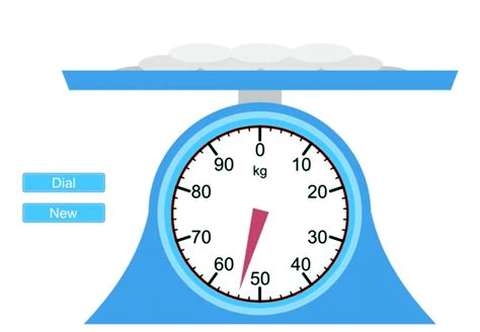
So, if we divided the day (1 Chronos) into 10 segments, each segment (1 DecaChronos) would equal 2 hours, 24 minutes. Each DecaChronos could be divided by 10 (that’s a single CentaChronos) and would equal 14 minutes, 24 seconds (about 15 minutes). Then each of those could be divided by 10 (a MilliChronos) and would equal 1 minute, 26 seconds, 400 miliseconds (about 1.5 minutes). A workday (8 hours) would be 3.333 DecaChronos (it is a third of a day). Nurses work 5.0 DecaChronos (12 hours or half a day).

While talking about new time divisions we might as well leap into weeks and months.
You know, of course, that December literally means “10th” month; November – “9th;” October – “8th,” and September “7th.” Great! Let’s use that. We have to eliminate 2 months to make it an even 10 months per year. If every year begins on a Sunday (and why not?) that allows 9 thirty-six day months and the 10th month will have 5 or 6 extra days (which would be used as holidays, by the way, replacing all those foolish Monday holidays through the year [there are 6 in 2025]. Almost a week of No school, No banks open, No postal deliveries, and for most adults No going to work). Then the new year begins (every year) on Sunday no matter what day the last year ended on. One calendar works forever if you just change the year at the top. Independence Day, Christmas, and other celebrations will on the very same day of the week every year. Like Fridays or Sundays, for example.
Think of all the ways this saves money. 10 billing cycles for credit cards, loans, internet, insurance, and utilities … saving businesses 2 mailings per year per customer. That reduces number of stamps needed if you are one who sends payments. No need to print millions of new calendars (Tree lovers will become ecstatic about that – fewer wasted trees). No guessing how many days in the month (and playing games with knuckles), except for December (the 10th month). [I vote to give up March and August.]
Once we moved to this idea of time and calendar almost no one would want to go back. Unfortunately we will never do it.
Copyright 2025 Donald Whelpley
[PLEASE NOTE that Don is always open to discussing the thoughts and opinions he shares here and welcomes comments as shared in the comment section. He doesn’t use other social media platforms and won’t see whatever you’d like to share with him if you post it elsewhere.
ALSO, Don is always open to offer his thoughts on various topics. If you have a specific request, you can let him know in a comment; he reads – and replies to – them all. ~ Sherry]

See more GUEST POSTS from Don!
Comments