SCHWA
Schwa is a vowel which doesn’t care. It is that sound in a word that you are too exhausted to say clearly. It is also the vowel which isn’t there, but is sometimes added. At times it is the vowel which is not said at all.
Yes, it is not very important to the proper pronunciation of words, but essential when writing them. Almost any vowel can be schwa, which is the Hebrew word for “nothing.”
As a new writer I am discovering that whole words can be schwa, (as) they are unnecessary. Sometimes entire characters in a novel are schwa. A couple years ago I was reading a sci-fi book, the secondary characters, whose lives were carefully developed in the first three chapters, were eliminated in the fourth chapter. The main character had not been developed enough to carry my attention alone. I struggled on for a couple more chapters until I abandoned the read. They were treated as “schwa” by the author; insignificant to the true story-line. I wondered why he had introduced them at all.
We are familiar with books where random characters are abandoned and forgotten. They never were important to the development of the main characters. A shop keeper, a lone rider, a passing acquaintance. They were temporarily useful. Murder mysteries seem to be full of such.
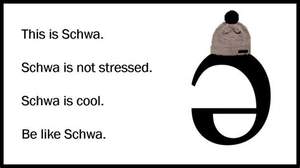
Speaking of which, I did not explain schwa as a character. It is the upside down, backward lower case e that you sometimes see in phonetics or in older books. Whatever vowel this phonetic character represents, its sound, when it has a sound, is the guttural “uh.” You hear it in words like “sofa,” “system,” “easily,” “gallop,” or “circus.” It often is dropped out of words like “every” or “chocolate.” Some people mistakenly add this sound where it doesn’t belong, like in the word “realtor” (which they pronounce real-uh-tor).
There is even a short book written by Neal Shusterman called “The Schwa was Here.” It is a story about two eighth grade boys who struggle to be noticed. One of them is Calvin Schwa who is nearly invisible and is ignored by the other classmates. He struggles until he meets a blind girl, Lexie, who does not notice his handicap. Nice book for students about the sense of self.
Catherine Morley is an English teacher who often takes her students on a tour of schwa in language. She writes, “Many of my students have seemed fascinated by the insight that English is not spoken as they thought, with every vowel being given its full sound, and after an initial introduction to the schwa they start to look for it themselves in other words and sentences. More ambitious students take every opportunity to practice this ‘native-speaker’ feature, while others revert to the full vowel sound after drilling, but in either case their expectations of how English sounds will have changed.”
Is schwa important? Nope. Not in the grand scheme of all things language.
A friend often, I mean often, says, “Communication is one of hardest things humans do.” He may be quoting someone else. It doesn’t matter. I think he is right. It is difficult to communicate well and bypass the junk which is toss-able, or unnecessary.
Thomas Mann is quoted as saying, “I know I am talking nonsense, but I’d rather go rambling on, and partly expressing something I find difficult to express, than to keep on transmitting faultless platitudes.”
I know I am equating several disparate concepts, one having to do with pronunciation, another with communication, and a third with worth of self. I am purposely. They seem to match fairly well in my mind. Maybe only in my mind.
Copyright 2023 Donald Whelpley
[PLEASE NOTE that Don is always open to discussing the thoughts and opinions he shares here and welcomes comments as shared in the comment section. He doesn’t use other social media platforms, as I do, and won’t see whatever you’d like to share with him if you post it elsewhere. ~ Sherry]

See more GUEST POSTS from Don!
Comments