INTERPRETING SCRIPTURE
There are many paths to false interpretation. There is only one path to the truth. That path starts and ends with KNOWING THE MIND OF GOD. Find God’s purpose for including those words.
THEOLOGY. Using theology to interpret Scripture is backward. If the Bible is God’s word, then why use man’s word to interpret? Theology should be informed by Scripture, not the other way.
CLARITY. Never use a less clear passage to interpret the more clear one. Always use the more clear to interpret the lesser. Some passages are so clear it is unlikely any other meaning is implied. Go first with the obvious. For less clear passages, other tools are needed.
IGNORE. Never ignore something just because you don’t understand it. ALL Scripture is useful, but not all of it has the same value. Proverbs are not as valuable as the words of Jesus. The Song of Solomon is not as valuable as Genesis. Don’t assume every Psalm verse declares something theological. (I am not endorsing the following website:)
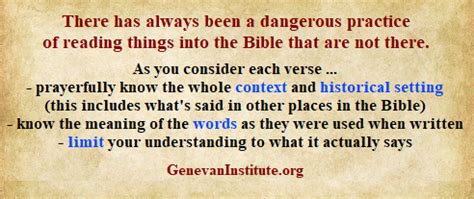
CONTEXT. Context is one of the more important parts of understanding any passage. And ignoring context ranks highly among Bible interpretation errors. Most find it natural to focus first on details and specific words. Studying the context takes a bit of time, but the reader cannot understand the author’s intent (the assumption is it is also God’s intent) without it. Who is the audience? Why did the author talk about this? What else did he say?
VALIDITY. All Scripture is valid. One should never deem a passage “no longer valid” unless another passage declares it to be. For instance, the Ten Commandments are still valid. The only one of those which has changed is “Remember the Sabbath to keep it holy.” When Christ rose from the dead on the first day of the week, even Jewish Christians honored that day as higher than the Sabbath (Friday sundown until Saturday sundown). For Gentile believers the first day of the week was seen as special. They didn’t have the rituals or micro-laws about their holy day as the Jews had for the Sabbath, but they honored God by remembering Christ’s resurrection on every “first day.”
REPETITION. When something is repeated it is worth knowing. Christ’s resurrection is repeated many times in the New Testament. It is worth knowing. In the Old Testament God told Noah “Do not eat blood.” It was repeated in the Mosaic laws. Then it was repeated again in Acts as a rule for Gentiles. Seems that is worth knowing, yet I’ve never heard a sermon on it (why not?) Animal and grain sacrifices went away BECAUSE of Christ’s once-for-all sacrifice on the cross. That fact is repeated in the New Testament.
OVER-PERSONALIZATION. Not every verse applies to you. Some apply to foreign nations or cities (like Nineveh). Some apply specifically to Israelites. Some apply to groups of believers (local churches like Laodicea).
HISTORY. History is not always doctrine, it is merely telling a story. For instance, the Book of Acts tells the story of the early church. You should not wait in an upper room for the Holy Spirit just because that is how it was done in Acts. It was one way God worked, but it was far from the only way.
CHAIN LINKING. One of the more common interpretation errors is to extrapolate from a biblical truth or verse and develop a doctrine based on human reasoning. This is chain-link theology, starting with a valid Scriptural truth, then building upon it with additional links using logic. Each link moves the student further from the truth. The end result is mere doctrine without God behind it. One such chain link theology fooled its students into deciding that God created evil and sin. He never did. You won’t find a text which says He did but you will find those which say that God hates sin. (Why would God create something He hates?)
EMBELLISHMENT. A friend waxes poetic with Scripture. He includes interpretative words, such as “always,” “never,” “all,” or “so” into a biblical text. This is particularly egregious since we are told not to add to God’s Word. For this reason I have some heartburn reading the Amplified Bible or The Good News Translation. They submit flexible options for the text. I enjoy the NIV, but it sometimes ventures close to adding things not in the original Hebrew or Greek in an attempt to make the Bible more readable. (Should you throw out the NIV? No. Just realize that for study you may want to refer to a more literal translation.)
PARABLES. Some do not understand that parables are teaching ONE THING, and many of the details merely set up the story. Recently I wrote about such an issue. A Christian chorus tells us that God “leaves the 99” to go after the lost sheep. Actually, that isn’t true. God never leaves his own, and he doesn’t need to because he can be in many places at the same time. In the parable Jesus reminds those to whom he is telling the parable, “Which man AMONG YOU wouldn’t leave the 99.” See? It isn’t talking about what God does at all.
NEGATIVE INFERENCE FALLACY. Scott Rogers mentions this one. If you look at Deuteronomy 7:6 he says that the Israelites assumed that since God HAD chosen them he HAD NOT chosen the Gentiles. That is what made the New Testament so amazing to the Jews … that God gave his Holy Spirit also to the Gentiles. What!!! They inferred something which never was there.
WORDS. Words have meanings. This is true, except that sometimes the meaning of a word in a particular Scripture passage is something different than how how WE use it. It is a good idea to not get wrapped up in theology when studying a passage. Do due diligence. Sometimes the same Greek word has more than one meaning. English meanings also change over time. In the 1700s John Wesley wrote regarding visiting the sick: “Be not nice.” “Nice” has changed meaning since. Now it means “pleasant or kind,” then it meant “ignorant.”
IGNORANCE. The worst kind of ignorance comes from not studying all of Scripture. I know people who wrongly accuse God of being vengeful and full of wrath. They are ignorant. Read Jonah! Nineveh was a city which deserved to be destroyed and that was God’s plan? Nope. His plan was to redeem them. He sent Jonah to preach of their coming destruction SO THAT they would repent and not be destroyed. The people living in the Promised Land were not wiped out because God was full of wrath. The prime reason was that they were evil people, burning babies to death in fires, practicing witchcraft, and performing a broad array of sins (like sleeping with close relatives, like mothers or daughters). God’s plan was to secure Israel’s purity. Ignorance causes fatal mistranslations.
PROOF TEXTING. Certainly don’t proof text and drive. There is no easier way to misinterpret Scripture than to insist you are right and piling a stack of references to “prove” it.

Copyright 2026 Donald Whelpley
[PLEASE NOTE that Don is always open to discussing the thoughts and opinions he shares here and welcomes comments as shared in the comment section. He doesn’t use other social media platforms and won’t see whatever you’d like to share with him if you post it elsewhere.
ALSO, Don is always open to offer his thoughts on various topics. If you have a specific request, you can let him know in a comment; he reads – and replies to – them all. ~ Sherry]

See more GUEST POSTS from Don
I’ve seen examples of all of these. Just Friday some friends were discussing a parable and got wrapped up in the spurious details. Wrong!
The details … Just set up the story. They aren’t usually all that important.
👍