FIRES & HEALTH
Did you know that NEARLY HALF of residential fires are caused by the kitchen range? What are the issues with that device which make it so likely to cause a fire?
GREASE. The number one cause is greases and oils (either in the oven or on the stove top).
Let’s think, “What is the best way to prevent a grease fire?” (I didn’t ask, “…the best way to put out…”).
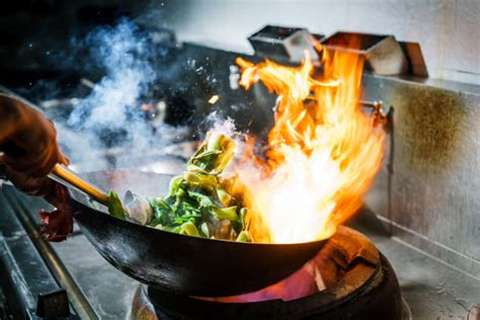
The number one way to prevent a grease fire is to never walk away from the stove top while frying foods. If the oil begins to smoke it is potentially ONE STEP from ignition (some oils can take quite a bit of heat before igniting, but it it is smoking you probably should lower the heat). Turn down the burner and remove the pan from the ignition source until the smoking stops.
The second way to prevent a grease fire is to clean up any spilled oils every time the surfaces cool. The same is true for the oven. If a significant amount of grease spilled in the oven and it is smoking, turn off the oven and cool quickly by opening the door. The oven should be cleaned (it doesn’t have to be spotless) of debris and greases at least every 6 months (sooner if you cook lots of meats or oily foods).
FLAMMABLE MATERIALS LEFT ON OR IN THE DEVICE. Never store anything inside the oven, even all-metal cookie sheets. Never place a potholder, dishtowel, or your plastic toy soldiers on the top. If it can melt or cloth it can burn.
ELECTRICITY. Your oven and cook top are metal. Do not operate any electrical device on or near it. And if you own an electric stove, if a circuit shorts it can cause a fire. (Hint: Ours was failing to always obey temperature directives just before we replaced it. The burner wouldn’t always go to “LOW” when it had been on “HIGH.”)

WHO WILL DIE IN A HOUSE FIRE?
You are thinking mothers and children. You are not wrong, but you are mostly wrong. Men are nearly twice as likely to die in a house fire as women. They are either poor cooks or heavy sleepers? If you’s a man, I’m recommending a smoke alarm!
DIET and ELDERLY
One’s diet is an odd thing. Do you want to live to age 80? Some claim that you are more likely to do so if you reduce processed foods and meats.
Are you 80 and you want to live to 100? The evidence suggests you should add meat to your diet.
Fox News reported recently (and I’ve made this comment before as well): “Older adults who avoid meat in their golden years may be less likely to reach age 100 than their meat-eating counterparts, new research suggests.”
I had looked into longevity for vegetarians about half a year ago and discovered the same fact. Here’s the math: Survival to age 80 for 1,000 with normal diet vs 1,000 vegetarians is nearly 10% lower. Then something changes in the nutritional requirements for older adults. Take 1,000 vegetarians at age 80 and 1,000 meat eaters at age 80, and suddenly the survival statistics showed that very few vegetarians reached age 100 compared to meat eaters. In fact, my research showed that only about half as many vegetarians survived.
I’m guessing that there is a transition stage where being healthy without meat declines and being healthier because of meat increases. It is unlikely that that transition point is exactly age 80.
COLORECTAL CANCER
Fox News reports that “Disease rising 3% annually among 20-49 age group…” The incidence of this one type of cancer is increasing for those under 65, while the incidence among those over 65 is decreasing.
I have a guess as to the cause. When I went to public school the lunches were made from scratch (potato flakes and water) along with some meat substance cooked on site, and canned vegetables. After I left public schools those same schools hired “food service” companies which were serving fish sticks, chicken nuggets, and potato chips (instead of mashed potatoes). Breading, oils, and fried stuff instead of cooked stuff. What is causing this kind of cancer? Public schools is my guess.
REGARDING CANCERS IN YOUNGER FOLK
Being vegetarian gives some protections from certain cancers, while increasing risk for other types.
Take the following with a grain of meat: Possibly a 21% reduction in pancreatic cancer, 12% reduction in prostate cancer, 9% lower risk of breast cancer, as well as 31% lower risk of melanomas, and 28% lower risk of kidney cancer.
For every benefit there are some higher risks, too. Being a vegetarian almost doubles the risk of the most common esophageal cancer, and presents a 40% higher risk of bowel cancer.
Plus and minus, I’ve met several people who had some of these cancers. None are good. To be totally safe from these cancers there is only one sure way: don’t eat anything. Apparently that has its own risks.
Well, see! You can learn something new without going to college!
Copyright 2026 Donald Whelpley
[PLEASE NOTE that Don is always open to discussing the thoughts and opinions he shares here and welcomes comments as shared in the comment section. He doesn’t use other social media platforms and won’t see whatever you’d like to share with him if you post it elsewhere.
ALSO, Don is always open to offer his thoughts on various topics. If you have a specific request, you can let him know in a comment; he reads – and replies to – them all. ~ Sherry]

See more GUEST POSTS from Don
About cleaning your oven … many experts recommend that you should not use the self-cleaning mode. They insist that your oven (and surrounding materials) may not be prepared to take the heat produced. What is next to your stove? … if your kitchen is like mine, the material immediately next to your oven is WOOD. It gets too hot it ignites.
Other experts claim there’s no problem with the self-cleaning mode.
I’m going with safe. It takes a bit more effort, but no fires have been ignited by properly applied oven-cleaners.
Many people with self-cleaning ovens and parrots have learned that, fire or not, they are not safe.
You would know. However, if it is not safe for birds … probably not good for people
Zackly.