REVERSIBLE DEMENTIA
Although never mentioned in articles about “scientific ways to reduce the probability of dementia,” here are some ACTUAL scientific ways…found in weird, unheard of places like the government’s National Institutes of Health (NIH) and Springer.com websites.
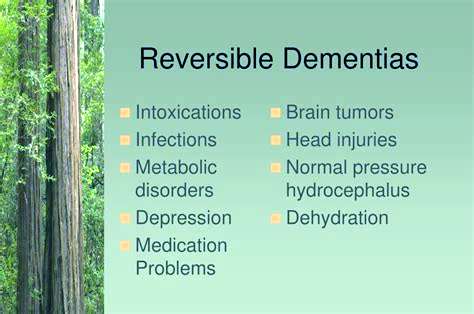
There is a moderate list of correctable physical issues which can cause dementias or symptoms of dementia. It is estimated that perhaps greater than 20% of dementia symptoms in people you know are caused by one or more of these.
For example, some prescription drugs can cause symptoms of dementia as a potential side effect. First, though, what are the symptoms of dementia?

DSM V, p. 602-605 criteria for dementia (Note: I find the criteria list in DSM IV more understandable)
Major Neurocognitive Disorder
Diagnostic Criteria:
A. Evidence of a significant cognitive decline from a previous level of performance in one or more cognitive domains (complex attention, executive function, learning and memory, language, perceptual-motor, or social cognition) based on:
1. Concern of the individual, a knowledgeable informant, or the clinician that there has been a significant decline in cognitive function; and
2. A substantial impairment in cognitive performance, preferably documented by standardized neuropsychological testing or, in its absence, another quantified clinical assessment.
B. The cognitive deficits interfere with independence in everyday activities (i.e., at a minimum, requiring assistance with complex instrumental activities of daily living such as paying bills or managing medications).
C. The cognitive deficits to no occur exclusively in the context of a delirium.
D. The cognitive deficits are not better explained by another mental disorder
Mild Neurocognitive Disorder
Diagnostic Criteria:
A. Evidence of a modest cognitive decline from a previous level of performance in one or more cognitive domains (complex attention, executive function, learning and memory, language, perceptual-motor, or social cognition) based on:
1. Concern of the individual, a knowledgeable informant, or the clinician that there has been a mild decline in cognitive function; and
2. A modest impairment in cognitive performance, preferably documented by standardized neuropsychological testing or, in its absence, another quantified clinical assessment.
B. The cognitive deficits do not interfere with capacity for independence in everyday activities (i.e. complex instrumental activities of daily living such as paying bills or managing medications are preserved, but greater effort, compensatory strategies, or accommodation may be required).
C. The cognitive deficits do not occur exclusively in the context of a delirium
D. The cognitive deficits are not better explained by another mental disorder.
So, yes, some prescription medicines can cause some of these symptoms (especially those prescribed to treat mental health, but others, too). Also, depression, hypo-thyroidism, tumors, lesions, infections (including syphilis or AIDS), or anemia (such as a deficiency of Folate, or Vitamin B-12). That is not a complete list.
Did you know that Metformin (a common drug used to control Type-2 diabetes) can cause B-12 deficiency? Diabetics should have regular blood work to monitor Folate and B-12 levels. This is a simple and cost effective first step.
Did you know that even a simple issue such as a urinary tract infection (UTI) can cause or worsen symptoms? I’ve seen that in people I’ve known. Totally “with it” one day, and NOT the next.
Blocked arteries can cause symptoms. Don’t run out and order a stent surgery, because often drugs and diet will do a more efficient job of clearing those tubes. Get a second opinion (two doctors, not me and one doctor).
Metabolic dysfunction can cause dementia. Anything from renal failure to hypoglycemia can cause symptoms. Sure, I have memory issues when my blood sugars crash. Don’t ask me questions, just give me food.
Of course, alcohol or illegal drug abuse can cause symptoms of dementia.
1. We are talking here of potentially reversible dementias. Allowed to exist too long, most of these simpler dementias caused by physical issues will become irreversible. That is why diagnosis and treatment early on is recommended.
2. There are several non-reversible and progressive causes of dementia, they include: Alzheimer disease (AD), vascular dementia (VaD), Lewy bodies dementia (DLB) and frontotemporal dementia (FTD). It may be possible to delay progressive symptoms in certain cases, but the diseases cannot be reversed with current medical science.
There are those who CLAIM onset of these diseases can be delayed but no valid scientific proof exists for that claim. Sure, do puzzles and have deep discussions of heady subjects, but don’t expect those to prevent or delay any non-reversible disease. They will keep you sharper if you don’t have a non-reversible dementia.
I hope this overview has been useful and helpful. Don’t assume the symptoms you see are because of Alzheimers, get the person to a specialist who will run the right lab work and other tests. 1 in 5 dementia symptoms are from a reversible problem.
Copyright 2025 Donald Whelpley
[PLEASE NOTE that Don is always open to discussing the thoughts and opinions he shares here and welcomes comments as shared in the comment section. He doesn’t use other social media platforms and won’t see whatever you’d like to share with him if you post it elsewhere.
ALSO, Don is always open to offer his thoughts on various topics. If you have a specific request, you can let him know in a comment; he reads – and replies to – them all. ~ Sherry]

See more GUEST POSTS from Don!
Frankly, WHY are these never mentioned in articles about things you can do to prevent dementia? Having a doctor evaluate you or a loved one could lead to solving a problem and ending those symptoms. That is a true gift to those individuals and their families. If someone seems to have dementia don’t put off getting a proper diagnosis. Jump into action.
I have no idea why diet and nutrition is never mentioned either, though there is a plethora of data showing that eliminating certain types of foods and concentrating on others can have a drastic effect on “dementia”.
@owly –
It is because writers spend very little time with research. They get paid by the article, not by writing something worthwhile. If reading an article about planning for retirement, for example, they have the same 7 points as all the other worthless articles. It is template-mentality (something about which I will post soon).
It isn’t that the information is hard to find, it is that they have 7 articles to write today. A template is far easier than research.