HANDICAP-FRIENDLY HOME
Life ain’t fair. At some point you will probably be on crutches or unable to climb stairs due to injury, surgery, or age-related issues. It may be temporary. One source declared that more than 1 in 4 people in the U.S. has a disability. Of those, about 7 million people use mobility assistance devices. Still, how long can you wait to go to the bathroom?
If you are planning to upgrade your kitchen, you should THINK HARD about how to make it more handicap friendly. For example, installing the microwave above the stove saves space, but more difficult for a person who is handicapped.
Now is a good time to reduce clutter, too. How many serving dishes do you need? We did a “Go through the Tupperware” party (twice)… matching EVERY bottom to a top. (You may have to search through the entire house…we found pieces in the shop, the garage, dressers, desk, as well as almost every cupboard.) Any item that did not have a match enjoyed a trip to the dumpster. Then we had a “potholder” party. It was amazing how many crappy potholders we found. Those also went “bye-bye.” Major de-cluttering is part of being handicap prepared.
If you are thinking about replacing your tub with a cheap tub insert…re-think that plan. What will be the benefit if you become partially disabled?
Of course, bathrooms are traditionally the worst room for the handicapped. They are small and crowded. The doorway may be less than 36” wide. There is absolutely no way a person with a wheelchair could use it even if they could get through the door. The sink is too high. The toilet has no grab bar and too low. The shower is inside a tub and has no safe place to sit. If re-doing the bath ask yourself a few important questions … Can a wall be moved? A wider door added? Grab bars and other accessories installed securely?
When we retired and moved to a new state we began looking for “handicap possible” homes. We are improving in age, but not disabled. The probability of disability rises for us each year. So, we had a “vision” for what would be an acceptable home.
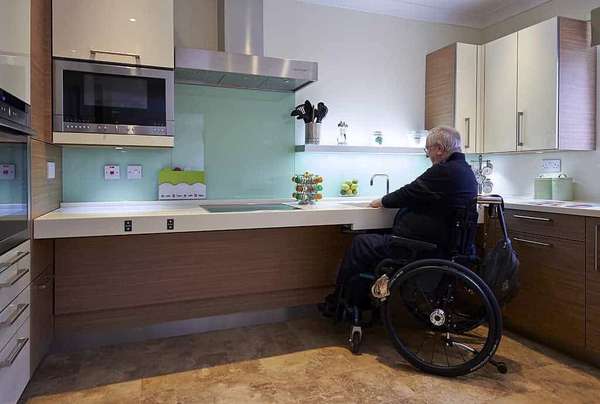
What makes it “possible?“
1) All on one level. No steps to bathroom or bedrooms. (We have a basement, but we can drive down to the exterior door.)
2) Main floor laundry.
3) Two bathrooms, including a walk in shower, and lots of floor space for a wheelchair.
4) A covered front porch (not a tiny porchlet).
5) A semi-open floor plan. (You want a wider hall or none.)
6) If there is a garage, 2 car, with only 1 or 2 steps into house.
Now inspect your home. Look at your home from a handicapped perspective. That sensational oval rug in the living room … is that a trip hazard? Do you really want the glassware to be stored on the 3rd shelf? Are knives jammed in the drawer next to the silverware? Are commonly used items stored where you need a step-stool to retrieve them? Does the kitchen floor become slippery when wet? Is your shower slip resistant? Is your HOT water too hot (would it burn someone with low sensitivity)?
You know, I am realizing that all the same issues I just mentioned may be dangers for young children, too.
If you want your parents or grandparents to feel comfortable visiting, these are good concerns to work through.

Buying that Retirement Home:
So, should you buy a new home BEFORE you retire? Yes. Here’s a little secret no one told us about: It is almost impossible to get a mortgage without a job (retired, see!), even if you have savings greater than many multiples of the value of the real estate you wish to buy. That almost sunk our boat! “What? I have to be working to qualify?”
It was true. We had money. We had a paid off house for sale. We had a great credit score. But no one would lend us a dime. Our only choice was a cash-only deal. If we had known we would have bought a house before retiring and made the move more flexible.
Over the years we explored many house styles we liked. Most we discarded:
LOG HOME. They are so beautiful! They also are impossible to care for when you retire. The outside has to be chinked, holes patched, and stained top to bottom every few years. There go all your summer weekends! Plus, woodpeckers, bees, ants, and termites love them.
TRI-LEVEL. For a long while this style sounded like a lot of fun. That was until we discovered how running up and down stairs for EVERY little task would be exhausting. Laundry in lowest level. Kitchen on main level. Bedrooms and BATHROOM on top. You want to eat, pee, or do a quick load of laundry? Use the stairs!
BI-LEVEL. Every stinking time someone comes to the door you are hurrying down half a flight of stairs! If you have a house like this you should never plan to have company.
TWO STORY. Great if you don’t have small children and you don’t have your aged parents come to visit. When you retire you will regret this choice (unless you have an elevator).
STANDARD RANCH. Great for the walking part of your exercise program. The house is 60 feet long and you will experience that many times every day. Plus, the hallway is a one-person-at-a-time affair. This, however, is the most practical for retirement or handicap.
Think about YOUR home. Could you enjoy it if you were handicapped?
[Reminder: Be looking for a short story just before Good Friday about failure and forgiveness.]
[PLEASE NOTE that Don is always open to discussing the thoughts and opinions he shares here and welcomes comments as shared in the comment section. He doesn’t use other social media platforms and won’t see whatever you’d like to share with him if you post it elsewhere. ~ Sherry]

See more GUEST POSTS from Don!
Several older couples I have met dreamed of having a two-story colonial when they had young families. Of course, they couldn’t afford it then. So, after the kids went off on their own, and money became a bit more free, they rewarded themselves with the homes of their … nightmares. It was the right house, but the wrong time.
No one uses the upstairs … haven’t in years. The heating and cooling is costing a mint. Stuck in a home 30 years too late!
I received a response to your post from my friend Royal: “Let Don know I appreciated this. I’ve found that outside of purpose built retirement communities, it’s hard to find houses designed with mobility needs in mind. If I suddenly came into lots of money I’d love to build many communities for the disabled, not so much for profit as for service.”
https://theres.life/@royal/112153730371570083
@Owly (and Royal),
Thanks.
Mobility is a need for retirees, for sure. Also for those handicapped.
We know what you say is true. There are very few homes that are easy to transform or built for mobility. When looking for our home we crossed off the list of those to visit by over 60 due to mobility issues. We only looked at homes which looked like they COULD serve our future senior needs. We toured less than 10, and half of those ended up not appropriate. Even the house we purchased had a first step to the front porch of over 12″ (which we soon corrected).