TERMITES
Imagine living your entire life underground, requiring a gut bacteria which can kill you if it gets on your skin, and eating wood for a living.
That would make anyone angry. It would make me angry.
Now imagine not having any serious defensive weapons except your bodily gasses and a large headed version of yourself whose only value is in blocking access to your home with her body. No stinger, no serious ability to bite an opponent. I will say that their body gasses are potent and do keep many attackers at bay (Global Warming causing, eye-stinging farts).
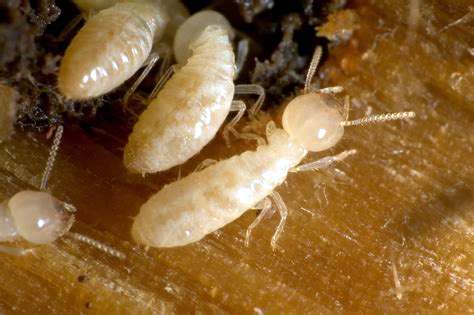
Subterranean termites don’t hibernate and the young don’t hibernate either. They demand to be fed year ’round. The workers must risk their lives in the heat of summer and the freezing cold of winter to bring back tasty snacks. Did I mention that they are virtually blind and only know where they are going by the smell the poop of others who have gone before them? How inviting, ‘eh? Yes, that is exactly how they find their way in the labyrinth of tunnels that snake through the sandy/loamy soil. No termite in its right mind would even attempt to tunnel through hard clay.
Further, all the exertion of travel and all the work of chewing and digesting wood requires a steady water resource. Often they choose a location which has a high water table, like a swamp or by a river, stream or under someone’s backyard pool.
I mentioned at the beginning that they cannot digest wood without one particular gut bacteria. Further, their digestive system destroys that bacteria. So, from time to time they have to go get a bite from the bacteria pile in their colony. If a termite forgets to groom properly that same bacteria will kill it. Grooming is essential for colony health. Imagine if the young were exposed to it!
For hundreds of years humans have sought strong ways to stop the destruction caused by these small white insects. They have tried heavy metals and acids. They tried super strong insecticides, too, like arsenates and chlordane. Every method used was overcome by termites because termites eventually figured out where the poison was and tunneled around the offensive product. There were two key issues for the termites, the pile of dead bodies near the poison and the funny taste in the soil.
Scientists discovered and took advantage of a new product (Fiprinil) which killed slowly (no pile of dead bodies near the poison) and had no taste (no chemical “odor”). Termites no longer had the two clues they needed to avoid the insecticide.
Even better, the new termiticide had a much lower percentage of active ingredients and, with a few additions, was now able to “bond” with the soil. Why is that important? Because the old time termiticides tended to leach down into water sources. This product is far less likely to do so. In addition, due to microencapsulation Fiprinil doesn’t “fade” like the older products used to. Dursban, for example, reached the end of its effective-life in about 6-8 years. These newer Fiprinil products remain effective far longer.
Whereas, a termite treatment’s effective lifespan had been 8 – 12 years, it now is 15 – 30 years (depending on location: Florida vs Michigan). Fewer treatments per century required, with far less active ingredient used.
So, the termites, not knowing Fiprinil is in the soil just tunnel right through it. But that isn’t the end. Termites do something odd. They rub against one another to “read” the biological signals from others. Sometimes their colony needs more queens. Sometimes they need more big-headed versions (soldiers). Whatever the need, it was communicated via those biological signals. Unfortunately for them, Fiprinil is also easy to share by rubbing against one another. One termite who tunnels through it can kill hundreds.
I mentioned the need for grooming. Fiprinil at extremely low doses makes termites forget to groom. An entire crop of young can be lost in just a few weeks.
The result is protection for a home that can last 30 years from one treatment. If the colony survives they will soon forget where the house is, feeding off of tree roots and fence posts instead.
How do I know? I treated hundreds of homes with the product. Often there was a stump in the yard, sometimes a mere 14′ from the foundation. The termites never stopped munching on the stump, but I could find no new activity in the structure.

There’s another set of products I also like, but there are “problems” with them. First problem, most people who agree to a bait system stop paying for it. The result is a home which has no continuing protection. Three years later the critters can return with nothing to stop them.
The second problem with baits is the cost. Cheap to install, expensive to maintain. A family can pay twice the cost of a Fiprinil treatment in less than 12 years due to maintenance costs.
The third problem with baits was the quality of the installation. I saw houses with maintained bait systems AND live termites. Poor installation = poor results. If you go this way, don’t go with the cheapest available.
The one really great benefit of bait systems = no toxic chemicals. If you worry about that or live on the beach or anyplace with super-high water table … use baits (but get the best and keep up the contract). Money is not everything.
How do baits work without insecticide? Insect growth regulators. Termites molt (grow) many times in their lives. The growth regulator makes it impossible to break out of their shell; it squishes them to death. (Neither you nor your dog need to shed a hard shell). Not pleasant, but effective.
If you live in a termite “zone,” like Kalamazoo, Michigan (sandy soil and high water table), or below the Mason-Dixon line … you should have professional termite inspections every 3 to 5 years. If you have had a Fiprinil treatment have a re-inspection every 5 years. If you have a bait system have it serviced annually. If you don’t live in a “zone” have an inspection every 10 years (because termites don’t know the rules).
Copyright 2025 Donald Whelpley
[PLEASE NOTE that Don is always open to discussing the thoughts and opinions he shares here and welcomes comments as shared in the comment section. He doesn’t use other social media platforms and won’t see whatever you’d like to share with him if you post it elsewhere.
ALSO, Don is always open to offer his thoughts on various topics. If you have a specific request, you can let him know in a comment; he reads – and replies to – them all. ~ Sherry]

See more GUEST POSTS from Don!
If you have a termite treatment, don’t let that company get away with merely servicing the bait stations or inspecting the outside. They should inspect inside (crawlspace, basement, attached garage, main floors and attic) the year after treatment and at least every 5 years thereafter. (It is worthwhile to pay for these inspections.)