EARWIGS AND SILVERFISH
They are not closely related.
Some reporters will tell you that neither are a big problem, but both can be. Let’s start in alphabetical order.

EARWIGS
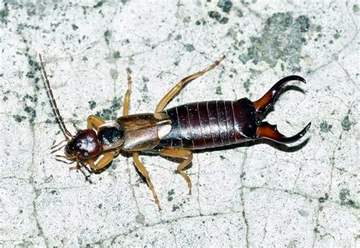
They don’t wear wigs and I’ve never heard of one getting into someone’s ear. These are those funny insects with pincers for tails. You may have already noticed that some have straight pincers and others have curved (wicked looking) pincers. These are not two varieties of earwigs (earwigs type A and type 2), but merely female and male. As in almost all of nature only the female can lay eggs. (Don’t allow anyone to tell you otherwise. This is science not politics.) The males have the strongly curved circi (pincers). The males use them for fighting pitched battles with other males (and they are strong enough to give you a painful pinch, too, if you try to pick them up.)
Earwigs eat plant stuff and other insects. They love moist areas, like wood piles and trees with rough bark. They also love hidden areas (like your well cap) and this is where they can become a true horror. They poop and they die. And if they poop and die inside your well casing it gets into your drinking water. That can make you ill. Since you can’t move your well to the middle of a sunny well-groomed field, AND since you should not use insecticides near your well, you need another way to control them there.
BINGO. I know how. They LOVE moisture, so give them another option near the well cap. Take a newspaper section (12-15 pages), get it damp, loosely roll it and put a rubber band around it. Place it next to the well cap overnight. First thing in the morning chuck it into a small garbage bag and tie it up. Repeat as necessary. About half the critters will be inside the newspaper.
If you are finding them inside your home you have a moisture problem…probably mulch too near the house. Try the newspaper trick for immediate relief. Then spray the outside foundation with a insecticide labeled for earwigs. Third, plan to change the issue that attracted them in the first place (trim the bushes, create a 3′ dry zone next to house without any mulch, move wood piles, etc.)
SILVERFISH
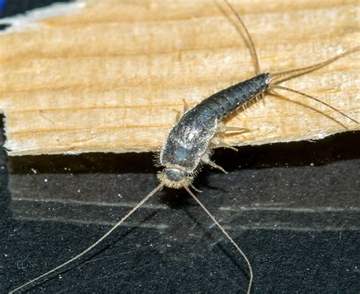
First, this is not really a fish. Don’t bother dangling a worm on a hook to catch them.
This is another critter which mostly prefers to live outside. In the deep south there is a cousin called “fire brat.” The cousin can handle the heat better. Just because they prefer the outside doesn’t mean they can’t set up shop inside. We have many starchy things in our homes which they enjoy eating. Cotton clothes stored in basements or attics (or that hall closet) are nice. Sometimes people think they have clothes moths, but if the items with the holes are made from plant fibers (like cotton or bamboo) the culprit is more likely silverfish (or crickets). They also like paper items, like wallpaper, textbooks, marriage certificates or tax files stored in the attic or basement. In those unconditioned spaces the humidity may be high enough to cause a little bit of mold to form, which makes the paper very tasty. Plus, since they can live up to 8 years, only a few can create serious problems.
The solution is a bit complicated. Step one: Discard what you don’t really need. Reduce the amount of food available. Step two: Dehumidify the storage space. This can be done in the attic by increasing ventilation. In the basement you need a dehumidifier. Set the humidity for 50% or lower. Make sure to buy a dehumidifier that is efficient enough for the space. Few single dehumidifiers are capable of controlling more than 1200 square feet. Get one with a pump if you can’t place it within 10′ of a sump or drain for the hose to work. (By the way, water will not drain uphill.) Set the machine ON THE FLOOR since it will only dehumidify down to where it sits (setting a dehumidifier on a countertop or table is useless). Step three: Insecticide or traps. Traps are nice since you can also trap spiders, crickets and earwigs, but the trap should have a food bait for silverfish on it. Otherwise, spray as needed a product labeled for silverfish along basement baseboards, window frames and ceiling corners.
The big problem: Type of insulation in your home. For a long time, starting in the 1950s, companies would create a cheap insulation using ground up newspaper sprayed with a fire retardant. Then they would blow it into wall voids and attics to add insulation (you’ve seen those homes with multiple hole caps on the exterior, right?) Unfortunately, this product is also tasty to silverfish. You can’t remove it and you can’t make it less tasty. If yours is a home with this insulation, you are going to have lots of silverfish. You can improve but rarely eliminate the pest. It never hurts to follow the three steps outlined above, but you may have to do more. For your attic (only if you NEVER go there) you can place a couple Vapona pest strips (“No Pest Strips”) there. Vapona is a toxic gas which will make you feel ill if you are constantly exposed to it. DO NOT USE IF YOU WILL BE EXPOSED TO IT for more than a couple minutes per week. (Also, do not use Vapona in story and a half structures where the attic is beside living spaces.) If you cannot use Vapona, you may be able to use boric acid granular baits (like for ants). Place the baits in small paperboard box lids (or oatmeal container lids) in several places. Use the lids to help you remember where you have placed them. You won’t need a lot of bait. (By the way, don’t throw boric acid powder into the attic because anyone doing work there will have to crawl through it and will need special gear to prevent inhalation. Boric acid is a “stomach poison,” so it has to get inside your body to do harm. Inhalation is a serious risk.)
Have fun!
[PLEASE NOTE that Don is always open to discussing the thoughts and opinions he shares here and welcomes comments as shared in the comment section. He doesn’t use other social media platforms and won’t see whatever you’d like to share with him if you post it elsewhere.
ALSO, Don is always open to offer his thoughts on various topics. If you have a specific request, you can let him know in a comment; he reads – and replies to – them all. ~ Sherry]

See more GUEST POSTS from Don!
EEEEWWWWWW
Yes, gwen.
… but tasty
(hahahahahah bu haha)
Mr. Don,
When we lived in upstate NY we could have used your sage advice re earwigs and silverfish as we had them both. Unfortunately, we didn’t have access to a friendly, experienced neighborhood bug man like you. Thank you again for advising us regarding Sarah’s squash beetles!
Thank you, Sally!
I learned most from keeping my eyes open, as well as ears and nose. Roaches stink, for example. Walk into an infested home and instantly know its going to be a tough day. Carpenter ants vs termites: smooth rounded galleries = Carpenter ants. Inside a wall Carpenter ants sound like someone is crinkling cellophane (kids today don’t know that sound).