A REVOLUTIONARY TALE
[This is a “story.” Understand that not all reported within is strictly historical, although most can be inferred from historical records.]
War is rarely justified when one inspects the results. Financially a loser. War is incredibly expensive. Loss of life is a loser. You can’t have war without killing lots of people (soldiers are people, too, you know!) Loss of pride. There’s nothing glorious about being in a trench in the cold, the rain, or blistering heat, relieving yourself in a bucket or eating with hands that haven’t seen soap in weeks.
Let’s talk about expected results. Each side plans to win. Half are wrong. Those are poor odds. In fact many times the “winner” loses more than the “loser.” So, the chance of failure is greater than “even odds. “ There are grand “reasons” and grand “hopes.” Yet the results are guaranteed to be less than grand.
The most common reasons for war can be summed up in three words: Greed, Power, Revenge.
Yet there are personal reasons which rise above the common: Love of country, Love of Family, Love of Freedom. Love is an uncommon reason for war. I would venture to say that Love may be the only valid one.
When it comes to the sins or holiness of men, each soul will be judged separately. God does not condemn all of humanity for the sin of Adam (if you do a careful reading of the Word). Nor will God condemn an entire nation for the sins of slavery; he never has. Each individual shall have his or her turn before the Judge. So, holiness or sin, each shall have a just reward. Children do not experience condemnation from the Judge for their father’s sin, nor does a father receive a righteous reward for the holiness of his children.
A broad stroke paints a forest, but no trees. So it is also with those who were enslaved and their masters. Whether we like it or not (and some will condemn me for telling the truth), some slaves were not saints (being human, each individual makes good or bad choices; tell me that isn’t so?) and some masters were not devils, even if the opposite may have generally been the case. It takes a close look at the details to determine each. Herein we will look and we will see that a broad stroke would miss telling a true tale.

I got to know a descendant of Daniel Boone. He attended the same small church I did. We talked several times about inconsequential things and never about his ancestor who played a large role in the history of the state.
One of the things Daniel Boone was known for, thanks in part to the TV show starring Fess Parker, was his life as a frontiersman at Fort Boonesborough. In one episode they even showcased the “cannon” his brother Squire created to defend the fort from attacking Indians. It actually happened. Squire Boone did use a hollowed log as a cannon during the siege … twice.
Roughly 440 Indians and about 12 French scouts moved against Fort Boonesborough on September 7, 1778. The Indians, led by Chief Blackfish had a report of close to 200 militiamen in the fort. It was true that a few months before there may have been close to half that many, but some had bugged out for safer territory and 11 had been captured at the salt lick where they had gone to secure salt to preserve the meat they needed for winter. So, there were 42 fighting frontiersmen there, more or less. Some of the wives dressed as men and carried old muskets around inside during the daylight hours to help convince the Indians that taking the fort was not a sure thing. The defenders were outnumbered 10 to 1. Actually it was worse. Those inside had a limited supply of food and gunpowder. They could not defend against an extended full attack, nor could they hold out if the siege went very long. They faked their way to success.
On behalf of those in the fort, it could be said that they had hope of being resupplied and strengthened by a militia coming from the East, but that hope was not fulfilled until long after the siege.
For 11 days of fighting the fort held. Alone. Outnumbered. Ill equipped. They had one major thing in their favor … they had a wall. Some think walls don’t work, but it is clear they do. For 11 days against 444 Indians with 42 fighting men, they outgunned and outsmarted their enemies because they had the benefit of a wall which they controlled.
Early in the siege, the French scouts suggested that the Indians could dig a tunnel under the fort wall and plant explosives. They would blow an opening in the wall and defeat the settlers. It might have worked except for two things. One, they were noisy. They didn’t dig deep enough, and as a result those in the fort could hear the digging. Those inside decided to dig a counter-tunnel to collapse the attacker’s tunnel. Neither was successful because of the second thing: It rained. The rain collapsed both tunnels and ended the plan.
However, this is where our story of two hero slaves begins. One slave was not at Fort Boonesborough at the time and the other was. Let’s tell the story first of he who was a slave at the siege. His name was London and his owner was Colonel Richard Callaway. Callaway was not a pleasant sort. He expected more of others than of himself. He also held grudges. Although there were few fighters at the fort he resisted the idea of teaching his slave how to use a weapon. However, the fort had 2 other officers in the Colonial army, including Captain Daniel Boone and Major William Smith. After careful consideration of their situation and a meeting to evaluate options Colonel Callaway ordered his slave to fight. London was given a weapon and taught how to use it. He had little training in warfare, but he knew he was fighting for his own life as well as all the others in the fort. If the Indians overran them, there was little chance any man would be spared, even a slave. Most of the women, too. The younger women and any children would be carried into captivity and suffer immensely as a result. The older women of the fort knew this as well. They made sure the men were fed and that shot and gunpowder were regularly supplied to them. The women ran errands, took turns at watch, and delivered orders from the Colonel, allowing all the men to be rested and available for the fight.
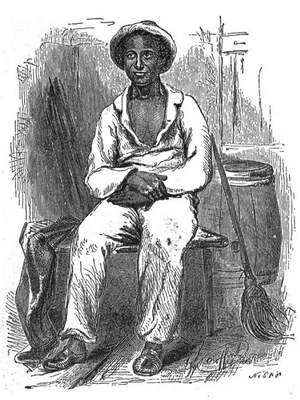
So, after as much training as necessary, London took his turns at the firing gaps. One night he was assigned to the gap behind the kitchen, for there were many cabins but all the food was cooked in a separate building away from the cabins so that if there was a fire in the kitchen building it would not burn down a family residence or fort wall. It was toward his post which the Indians were digging their tunnel. That night he saw activity by the river, where the tunnel began, and he took aim. The weapon kicked like a mule, but he was ready for it. He quickly reloaded as another defender moved to give him support. He shot again at the activity he saw. That was what the French scout was waiting for as he hid behind a tree to the side. He knew the exact spot where the slave’s gun discharged and he fired immediately to the same point on the wall. The bullet hit the slave full on. He fell and died almost instantly. His inexperience in fighting meant he didn’t move away from the gap immediately after firing. He and David Bondurant were the only two of the defenders killed during the 11 day siege. Three others were injured. Many more Indians lost their lives in their attempts to attack, and in some cases, in their attempts to burn out the inhabitants by throwing flaming torches at the roofs. Only a few torches hit their targets and started fires. Squire Boone, Daniel’s brother, devised a type of “squirt gun” from old musket barrels with a bag of water attached. Squeeze the bag hard and the water shot to the fiery targets and put out the fires.
After the end of the struggle, Colonel Callaway, brought military charges against Daniel Boone. It was Boone who had both rescued two of Colonel Callaway’s daughters from Indian capture a year earlier and had organized most of the effective fight against the attackers of the siege. Daniel Boone was acquitted by the court and was promoted in rank. That irked the man.
Callaway petitioned Continental Congress for reimbursement of his “loss.” That got him nothing. So, the broad strokes of “slavery is evil” do not paint this man’s picture as clearly as they should. He had an vile force within which ran deep. God has a special reward for men of that ilk. About a year later he had purchased more slaves and obtained a license from Virginia to build a ferry service to cross the river. Because of he failed to provision his slaves with weapons and the knowledge of how to use them, both he and they were killed by Indians where they were working not far from Boonesborough.
Delicate brush strokes show the character of a man.
“The Richmond Register” reported another story of a slave in Kentucky during the American Revolution. The fine strokes paint a much different picture in this case.
Monk Estill, slave of Captain James Estill, after which Estill County is named, was in the area a few years later. He spent some time at Boonesborough and then moved to Estill’s Station (which also had a small fort) just to the southeast of present day Richmond, Kentucky. On March 20, 1782, the fort was raided by Wyandot Indians. A young girl was killed and Monk was taken captive.
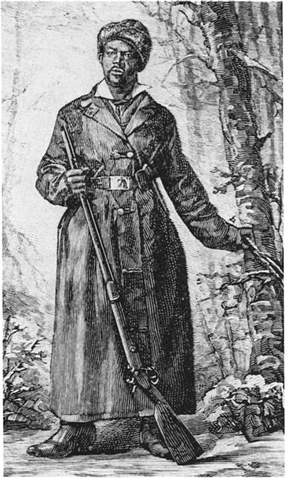
The Indians questioned him and he smartly exaggerated the number of fighting men at the fort. The Indians decided to put off the attack until more braves could join them. “Two days later,” the paper reported, “the raiding party was tracked down and attacked by a force of 26 settlers led by Capt. Estill at Little Mountain, near present-day Mt. Sterling.”
Captain James Estill was killed, and 13 of his fighters were killed or badly wounded, according to historical research. While the battle waged, Monk found a way to escape. However, he didn’t just flee, he carried one of the wounded, James Berry, back to Estill’s Station (about 25 miles). He was a strong man, although he was only 5 feet, 5 inches tall.
Because of his heroic service, Captain Estill’s son granted him his freedom.
Then Monk went into business creating gunpowder (a needed product), and tanning hides. Later Monk became a Baptist preacher. He married three times and had many children.
Here is where the fine strokes show the truth. In his old age, it was the Estill family which provided for his needs until his death in 1835.
Two slaves who fought for the Independence on the American frontier. One died a slave for a greedy man. The other secured his freedom for his bravery, lived as a free man, and was provided for by his former masters.
Broad strokes would not tell you their stories. Fine strokes show that not all people are the same. Both stories, however, show the willingness of these frontier slaves to fight for life and freedom.
[PLEASE NOTE that Don is always open to discussing the thoughts and opinions he shares here and welcomes comments as shared in the comment section. He doesn’t use other social media platforms and won’t see whatever you’d like to share with him if you post it elsewhere.
ALSO, Don is always open to offer his thoughts on various topics. If you have a specific request, you can let him know in a comment; he reads – and replies to – them all. ~ Sherry]

See more GUEST POSTS from Don!
Comments