JORO: GIANT “FLYING” SPIDERS!!!
Here’s a recent Newsweek headline: “U.S. Facing Invasion of Giant Venomous Flying Spiders.”
Reporters are trying to scare you into thinking there is an invasive spider (Joro) which can fly. They are lying (mostly) to you. The truth is far less frightening. There is nothing here to fear.
Fear sells! Otherwise they wouldn’t make those movies or print news.
?️?️?️
First, the truth is that there is not a spider anywhere in the world which can “fly.”
However, I remember one Sunday afternoon years ago when I was attempting to take a nap in my recliner. Things were floating through the air outside. Lots of things. I knew instantly they were baby spiders. See! It is a common and normal experience for newly hatched spiders to use static electricity and a little bit of silk to disperse from the place they hatched by jumping into the air and floating (“ballooning”) until they land up to several miles away. Too many spiders in one location (in our case, the pine tree in the back yard) would mean starvation for most of them.
This was a native and natural Michigan spider hatching. You can’t keep all spiders out of your house if they can float through the air and land on your roof or siding. Well! We do live in a wild world!
So, yes! Spiders CAN float on air currents, but only when very young. A successful spider who has found plenty to eat would soon become too heavy to take advantage of science.
Second, there are only a few varieties of spider which can jump…if you consider 1-3 inches a “jump.” I’ve never seen one jump off of a high surface to attack a human or pet. They just wouldn’t. They aren’t cats; it would be difficult for them to land on their feet since they are generally top-heavy. Plus they prefer to use silk to travel more than a few inches down. Spiders aren’t born stupid. They understand gravity.
?️?️?️
Third, Joro spiders are considered large as spiders go. They aren’t that big generally unless they have found a successful place to feed regularly. I have seen spiders in Michigan and Kentucky wild areas which would rival a Joro spider. One time I saw a 4 ½ inch spider on the siding of a forest home. Lots of food equals lots of size if you are a spider. I’m uncertain what the upper size limit of any spider is.
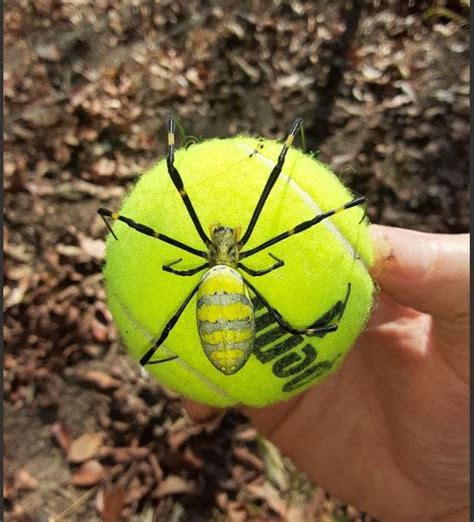
I talked with a customer once who had a “pet” spider that had taken up residence on his front porch. He fed it every day with insects he had trapped. He said his “pet” spider was huge (over 3 ½ “), but other spiders of the same variety near his house were an ordinary ½ “.
So, even if Joro spiders end up near where you live they will probably be no more of an issue than any other ordinary type of spider. Thankfully, they prefer to live outdoors. They have no doorknob skills.
?️?️?️
Fourth, one more falsehood being bandied about by reporters trying to sell papers is that Joro spiders are venomous. Truthfully, almost every spider is. The question is how venomous? Few varieties of spider have enough to make humans sick or die. Black widow spiders (a category of spider) generally have enough venom to harm humans. However, some states have a spider in this group whose venom is much weaker and few worry about them (Northern Widow). Brown Recluse is also a troublemaker. She (or he) can make your life miserable (both have sufficient venom and he is more likely to wander about). Compare those to the Joro spider … lots of venom volume in its bite, but not much punch. So, forget about it! They are unlikely to bite if you are gentle with them (children play with them in the country from which they came). If they do bite I’m told it feels like a mosquito bite. They have only 2 uses for their bite…to protect themselves from attack and to sedate their prey.
Finally, regarding Joro spiders, what is the greatest “risk?” Answer: their webs. You walk through one and you will KNOW you walked through a spider web. However, Joro spiders are generally careful to build their webs where they will catch things they can eat. YOU, on the other hand, are not in that category. As a result, they rarely build where there is open space below it. They aren’t interested in rabbits, squirrels, dogs, deer, or people. So, don’t expect one to be strung across a trail. They prefer to attach webs to bushes which are close to one another where insects normally fly. (Also, beware any Joro loan shark. You can keep your kneecaps if you pay on time. – Joke)
On rare occasions, Joro spiders have been known to kill small birds. Please note, this is not their normal lunch. Lots of things attack small birds, including bigger birds and cats. Most people don’t worry about being taken down by a stray cat. Right?
?️?️?️
OK. Now that I have dispelled the myths reporters are trying to scare you with…are there any questions?
[PLEASE NOTE that Don is always open to discussing the thoughts and opinions he shares here and welcomes comments as shared in the comment section. He doesn’t use other social media platforms and won’t see whatever you’d like to share with him if you post it elsewhere.
ALSO, Don is always open to offer his thoughts on various topics. If you have a specific request, you can let him know in a comment; he reads – and replies to – them all. ~ Sherry]

See more GUEST POSTS from Don!
Comments