ORDER OF ADJECTIVES
If you really want to screw with someone when talking, try changing the order of adjectives in your sentences. They will understand you, but it will irritate them. Some will correct you. Many never learned there is such a thing as the correct order. However, foreign English speakers DID learn this in their classes, even if you didn’t.
When the adjectives are out of order, even if you never learned the order in class, you will know instantly that something is wrong. Most of us grew up with it. It is a natural part of our language.
How is this used? Well, the importance of order only occurs when more than one adjective is placed before a noun. It is rare to find more than 3 adjectives before any noun, but sometimes an excited person is known to use more.
Why is there an order? No one knows for sure.
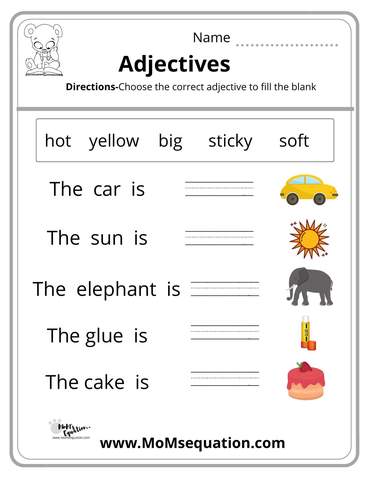
If you want to emphasize something, the order can be changed.
Normal sample: “The large, boxy, red car zoomed down the road.”
Emphasis on shape: “The large, red, boxy car zoomed down the road.”
The order of adjectives is this:
1. Opinion. Such as “pretty,“ “horrible,” or “ugly.”
2. Size. Such as “huge,” “tiny,” “gargantuan,” or “infinitesimal.”
3. Age. Such as “old,” “new,” or “young.”
4. Shape. Such as “round,” “oval,” or “flat.”
5. Color. Such as “green,” “blue,” or “red.”
6. Origin. Such as “Chinese,” “French,” or “American.”
7. Material. Such as “cotton,” “plastic,” or “wooden.”
8. Purpose. Such as “writing” (what kind of paper), or “dress” (what kind of shoes).
Some sources include additional types of adjectives, or list a different order, but almost every adjective can fit inside these 8. I will just say this: There are some exceptions to these language rules, but not many.
The first letter of the order spells “OSASCOMP.” That never helps me, but some achieve great comfort knowing such things. Mignon Fogarty came up with that, if you are interested.
What about words like “a”, “some,” “several,” etc.? OK. They have a special rule. They are called “determiners” and they go at the beginning.
There are a few adverbs that kinda’ act like adjectives which can also go at the beginning or right after a “determiner” if there is one. Those are words like “really” (think Ed Sullivan), and “very.”
Why am I interested? Well, as strange as it may sound, I grew up near the Pennsylvania Dutch area. That group did some strange things with adjectives (and other parts of speech) and it rubbed off on our community. As a result I have not always known the correct order (and still don’t sometimes). There are times (too often I feel) when I have to re-edit my work when reading it aloud. I read aloud almost everything I write just to catch my adjective mistakes (plus I sometimes find that I knew what I was talking about, but a reader wouldn’t have a clue if I did not add a word or two).
There are some who can’t read quietly. They cannot ignite the imagination in their brains without hearing the words. To help those folks it is important to keep a good order to one’s adjectives. On the other hand, my imagination runs in overtime, reverse, vertically, and in colors. I often can’t turn it off even when I sleep. I woke up this morning needing to check on a fact. The need to check preceded my awareness of being awake. There was nothing to do except get up and check … otherwise that “need” would not have allowed me to go back for the remaining 45 minutes I needed.
“The urgent, blue, mountainous need would have kept me awake.” (Emphasis on “mountainous.”)
Practice:
I will provide several sentences and the adjectives which go with them. You put them in the correct order…
a. Bill went to the store. (big, hardware, local)
b. Jack and Jill went up the hill. (steep, grassy, beautiful)
c. On his way home, Sam ate at the restaurant. (riverside, greasy, old)
d. Jumping for joy, Wilbur hugged his dog. (faithful, old, hairy)
See! That wasn’t so hard, was it!
When to use a comma:
When two or more adjectives come from the same category, they need to be separated by commas. For example, if you are describing the marbles in a bag and they include several colors: “The bag contained red, green, and blue marbles.”
When your adjectives come from different categories, they aren’t separated by commas.
Never use a comma between the final adjective and the noun it’s describing.
Finally, never put a comma between a noun’s determiner (“Some”) and the adjectives.
Have fun with your adjectives, folks, and don’t stress out about it.
Copyright 2024 Donald Whelpley
[PLEASE NOTE that Don is always open to discussing the thoughts and opinions he shares here and welcomes comments as shared in the comment section. He doesn’t use other social media platforms and won’t see whatever you’d like to share with him if you post it elsewhere. ~ Sherry]

See more GUEST POSTS from Don!
Comments