less is MORE?
If “less is MORE,” why aren’t people clamoring for it?
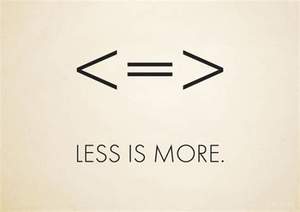
Yet, when people look at products they often buy the item with MORE features, than fewer. This is true even when the customer has no desire to use the extra feature(s).
When car shopping, you can find some models that come with an umbrella in a special umbrella slot, or one with a cooler built into the center console. Those who buy such extras report that they seldom use the gadgets. What about a special camping package for the SUV? Again, they are seldom used. They cost thousands more for a small amount of convenience. If you were shopping at an after-market store you probably would not drop $489 for special floor mats, but if they were extras in a new vehicle you would?
For many years I imagined that if a car manufacturer developed a “common man’s” car it would sell like hotcakes. Basic transportation, hardly any gizmos, 4 doors, decent gas mileage, no lemonade, and comes in a choice of 4 colors (none of which would be black or gray). It turns out I was very wrong. People don’t buy good simple value, they buy glitz.
I don’t need a car to tell me I’m going off the road, auto-dim mirrors, or automatic high beam headlights. I also don’t need the car to determine the right seat height, or when I would want my butt warmed. I just want a less expensive, safe, efficient, long-lasting vehicle. I don’t need “fins” or blue headlights. Here are the extras I desire: AM radio, cruise control, air conditioning, and a mirror on the passenger side (in the olden days that was the “extra”). I certainly don’t need Bluetooth. (I’ve tried it and … can live long and prosper just fine without it.)
I was reminded of some experiments in this arena when I read an article published April 7, 2021 in Ars Technica by the science editor…
In the article he reported that most don’t even think of removing parts. A few recent studies asked intelligent people to “fix” something. It could be a design or a device. In almost every case the participants tried to fix problems by ADDING something. Given a home design, and being told the family which owns this house needs an extra guest room, the participants looked for the best location to add a new room as part of the structure. In other words, they did not look for a space which could be re-purposed.
Researchers from the University of Virginia suggest that this tendency to ADD features rather than SIMPLIFY may underlie some of the growing complexity of the modern world, summarizes Jim Pennucci.
It is funny, too, because we see evidence of ADD-ism all around us. When it comes to the arena of business and other fields there is PLENTY of specific advice about improvement through deleting things. Two examples were mentioned: Writers are cautioned about using excessive language and social scientists talk about the need to remove social barriers. When was the last time you were reminded to add something to fix some problem? Likely never.
One experiment with solving problems involved using colored tiles and creating a pattern. Most of the tiles were already in place (though not necessarily in a helpful pattern). They found that only 1 in 5 participants thought about removing tiles already in place to solve the puzzle.
If you ever have been in a meeting at work to discuss the solution to a problem, you know that no one ever suggests ending the program which is causing the problem. Almost all the suggestions are about what can be added to the existing program to make it better.
Another? OK. A group of participants in another study were tasked with improving a travel itinerary. Obviously, the researchers over-packed the program with too many places and stops. Yet, only 28% of the participants suggested that some destinations could be eliminated.
So, apparently the idea of “less is MORE” has not caught on.
Why?
1. Clearly there are times when more really is more.
2. Sometimes we feel cheated when we get the “usual” amount.
3. We cringe when we are told to throw out a good idea. (Happens to me often, and I really hate it! I wrote THAT. I put it in on purpose. However, once I have made the decision to abandon it I usually like the result.)
4. We are used to having MORE. Bigger and More has become a “standard” … a bigger vehicle, house, boat, wider roads, larger grocery store, more choices. In America, many families discard more fruit and vegetables than they eat. Grapes sit in a bowl on the table, like a flower arrangement. We would rather have too much than just enough.
5. Finally, often we don’t even consider that less may be better for us. One reason I don’t always look forward to going out to eat is that the portions are huge. So often my wife and I would have been better off buying one meal and two plates. Otherwise, either we stuff ourselves or end up with a leftovers container in the refrigerator. Since we are both successfully watching our weight going out is rarely a “best choice.”
You could call it “consumerism,” except that this problem is found in every vein of life. “Less is MORE” is really about simplifying our lives, our homes, our family experiences, and finding joy by being WITH, and having ENOUGH.
Copyright 2023 Donald Whelpley
[PLEASE NOTE that Don is always open to discussing the thoughts and opinions he shares here and welcomes comments as shared in the comment section. He doesn’t use other social media platforms, as I do, and won’t see whatever you’d like to share with him if you post it elsewhere. ~ Sherry]

See more GUEST POSTS from Don!
Car companies should be making the old car that backyard mechanics can work on.
They can’t even make one THEY can work on.
EVs are killing the car companies. They are losing so much money on EVs that some are close to bankruptcy. Politics and business mix poorly.
Thanks for the comment, Thomas.